
curriculum
Science
The Subject Way
Firstly, to teach students the vital skills they need to achieve their full potential and gain the very best grades they can. Secondly, to teach students how each subject relates to the wider world, incorporating the life skills they will learn.
It is our belief that knowing how what you learn links to the wider world brings a subject to life and therefore improves overall understanding and engagement.
What do employers think about the subject?
For many careers, good Science qualifications are essential.
These include careers such as Nursing and Health Care, Child Development, Engineering, Architecture and Construction, Surveying and any other careers that have a technical aspect.
Employers at all levels see Science as a desirable qualification, as it shows that students are able to demonstrate a wide variety of skills essential in the workplace, such as analysis and interpreting data, applying knowledge and researching.
Curriculum Intent
At WPT we understand that getting the curriculum right for each and every individual student is the single most important factor in ensuring progress, encouraging positive engagement and raising aspirations.
At WPT, we want all students to leave able and qualified to play their full part in an ever-changing world through an ambitious, creative and innovative curriculum, which empowers students with the skills, knowledge and attributes to allow them to succeed in their next phase of education and their working life.
We aim to engender a love of learning, self-belief and aspiration through four key intentions:
- The removal of barriers to learning
- Developing skills for learning
- Developing personal attributes (School Way)
- Enriching student experiences and broadening their horizons
Our curriculum is not driven by performance tables. It is our belief that a strong, broad, balanced curriculum, tailored to individual needs can remove their barriers to learning and allow all students to access the curriculum appropriate to them and will therefore meet their individual needs.
We believe in a strong foundation of core subjects including English, Maths and Science. All students who are identified with deficits in literacy and numeracy are given additional curriculum support. These core fundamental skills are essential in both accessing our broad curriculum offer and the next stage of life; be it education, employment or training.
INTENTION 1 – The removal of barriers to learning
We want all our students to go out into the world, and become successful, happy, fulfilled adults who will be good citizens and make a positive contribution to society. The acquisition of basic skills is either at the heart of achieving this or a barrier to learning and prevents students from fully flourishing. Four common barriers, if left unchallenged, will limit the progress, engagement and development of students who access our curriculum. We see these barriers as a high priority for all schools. In order to prevent them from becoming a barrier for student development and progress we implement (and closely monitor) the following strategies:
Literacy
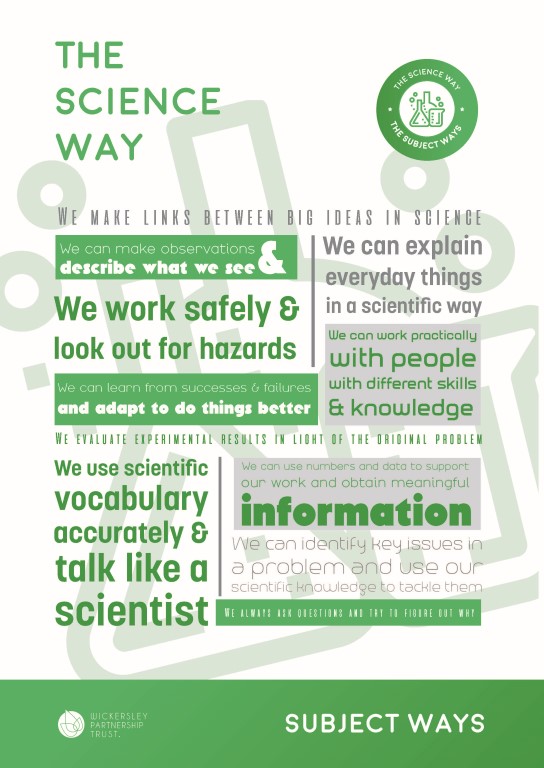
Pupils are given the opportunity to learn about the different ways in which scientists engage in their work, through reading, talking, writing and representing science. Science lessons provide opportunities for students to engage and read scientific texts and materials beyond the national curriculum. Literacy strategies allow students to deepen their understanding of Science and effectively communicate key ideas. Knowing how to read and write scientific texts and diagrams, for example, facilitates students’ understanding of complex scientific knowledge and processes. In Science we support students developing their disciplinary literacy in a number of ways. Strategies and activities for reading challenging textbooks, articles and exam questions are explicitly taught and revisited regularly.
Firstly, we expose students to texts which are suitable to their ability, high-quality textbooks are used as an important resource for learning and teaching Science, as well as exposing students to Science articles that are suitable to their ability. In lessons students are given time to read and understand the text by using Reciprocal Reading strategies. Students are encouraged to take their time reading texts, and then identifying key words, command words and any words which they are unsure of. By addressing these areas, students are more confident in their reading abilities. We support students’ writing by helping them to plan their work and providing scaffolding for those students who require this. Students are encouraged to plan their answers, and we regularly model how to structure extended answer questions.
Secondly, we support students’ writing, particularly for extended writing tasks by modelling how to structure these questions, along with providing time and help in supporting students in planning their work. In addition to this, we provide scaffolding for those students who require this. When work is marked by teachers, incorrect use of keywords, spelling and punctuation are highlighted in order to further develop students’ literacy.
Numeracy
Numeracy plays an important role in the Science curriculum. We introduce ideas at an early stage, with data handling being a key part of our curriculum. We work in conjunction with the Maths Department to introduce Maths skills at an appropriate stage with a consistent approach to teaching throughout the curriculum.
A major part of the Science curriculum is based around mathematical skills and their application. These include representing data in graphical form, handling and analysing data and multi-step calculations. In Science lessons students get regular opportunities to practice mathematical skills in Science and develop their scientific knowledge to deepen their understanding of how to process and present scientific data in a variety of ways to explore relationships and communicate results to others.
Oracy
Oracy plays a vital role in Science lessons, allowing students to assess knowledge and challenge deeper understanding. We support oracy within lessons by encouraging students to speak about their ideas, prompting pupils to use the correct scientific vocabulary and speak in a formal manner. Students are encouraged to talk like a scientist when giving verbal answers in class strengthening the use of correct science vocabulary. Key words are often displayed and highlighted within lessons to help encourage students to use them.
Science lessons provide opportunities for students to ask questions and participate in small group discussion. Students are taught how to engage in structured exchanges of ideas through various forms of debating, enhancing confidence in public speaking whilst also teaching students to consider alternative perspectives.
Vocabulary
Within lessons, there is a strong focus on vocabulary, specifically scientific vocabulary. Science is heavily dependent on the use of the right terms, and to help this we encourage students to define and use keywords. Word Walls are used with some groups to help to support their use of scientific vocabulary, and provide a database which students can refer to at any point in the lesson. We pay particular attention to trying to link scientific words to the words we use every day, highlighting common roots for words and identifying common prefixes and suffixes. For example, students are taught that the term Liposuction links directly to the word Lipids – the scientific term used to describe fats and oils.
INTENTION 2 – Developing skills for learning
Developing student knowledge and essential learning skills go hand in hand. Students need to remember with fluency in order to be fully established mini-subject specialists. We strive, at all times, for personal excellence by developing the six key skills for success:
- Recall
- Interpretation
- Creativity
- Analysis
- Evaluation
- Divergent thinking
As a subject we develop critical thinkers that have a curiosity about the world around them. Students are encouraged to always ask questions and try to figure out why. We want our students to never give up trying to solve challenging problems and make observations about the world around them. Students in Science make links between the big ideas in Science connecting key ideas to gain a greater understanding of scientific phenomenon.
Within lessons there are regular opportunities for students to look back at previous content to allow them to practice recalling and using concepts and content. Practical elements of the course allow students to generate plenty of data giving opportunities to analyse and interpret findings and create conclusions in line with observations and scientific knowledge. In order to fully grasp and convey complex scientific ideas students use and create models throughout all three branches of Science. Various topics throughout the course lend themselves to in-depth, detailed evaluation, we try to ensure these fit in with current popular themes.
INTENTION 3 – Fostering personal attributes
Our curriculum promotes the skills and attributes our children need in order to develop the independence, responsibility, accountability and resilience they need to have a happy and successful life. We refer to this crucial aspect of our curriculum intent as The School Way and it is embedded in everything we do.
The Science Way enables us to develop well-rounded individuals ready for the next stage. It is about embedding employability skills such as resilience, collaboration, communication, aspiration, responsibility, tolerance and respect in order for them to be an active participant in the local community and beyond.
The School Way is embedded in assemblies, form periods and our extra-curricular programme. It is the language that we speak and key aspects of the School Ways are as follows:
- We are nice to people
- We say please and thank you
- We are equipped to learn
- We work hard
- We are prepared to make mistakes
- We listen to others
- We believe in ourselves
- We are proud of our achievements
- We take pride in our appearance
- We take responsibility for our actions
- We are ambitious
- We take risks
INTENTION 4 – Enriching student experiences and broadening their horizons
Our intent is that all students have a full understanding of how to develop themselves as well rounded citizens, maintain healthy relationships and understand how to keep themselves safe both online and in their day-to-day life. We want all students to know what options are open to them in the future and understand the routes they have in order to progress on their life journey.
Our curriculum will include:
- Links with local industries and national organisations providing opportunities for students to engage with innovative external speakers, events and resources
- Opportunities for students to visit University Science Departments and experience exciting and engaging cutting edge science days to raise the aspirations and awareness of our students
- Chance to undertake independent projects based on their individual enthusiasms. These projects will help our students develop their communication and team working skills and encouraged cross-curricular collaboration
- Industry linked projects that will allow students to become involved with local specialist companies and compete in national competitions
- Science based activity days to engage and enthuse students in STEM subjects
- Opportunities to complete Faraday Challenges for the Institution of Engineering and Technology – designed to promote teamwork and raise the profile of STEM subjects
- Link up with your local universities to bring cutting edge research into the classroom including genetic engineering and medical research
- First hand fieldwork that provides students with opportunities to develop experiences in areas of interest and work in the local and national environment
- Science and STEM clubs that allows students to engage with Science topics and experience practical activities that are not covered by the national curriculum
- Events and projects linked to the
British Science Week
Year-by-Year Subject Breakdown
In Year 7 your child will study:
- Cells
- Structure and Function
- Reproduction
- Particles and their behaviour
- Elements, Atoms and Compounds
- Reactions
- Acids and Alkalis
- Forces
- Light and Sound
- Space
Your child’s progress will be assessed using in-class quizzes and tests, summative assessments at the end of each half term and a cumulative test at the end of the year, which will test everything they have learnt throughout Year 7.
Typical homework your child might get in Year 7 is:
- Online quizzes
- Short and longer style questions
In Year 8 your child will study:
- Health and Lifestyle
- Ecosystems
- Adaptation and inheritance
- Periodic Table
- Metals and Acids
- Separation Techniques
- The Earth
- Electricity and Magnetism
- Energy
- Motion and Pressure
Your child’s progress will be assessed using in-class quizzes and tests, summative assessments at the end of each half term and a cumulative exam at the end of the year, which will test everything they have learnt throughout Year 8.
Typical homework your child might get in Year 8 is:
- Online quizzes
- Short and longer style questions
In Year 9 your child will study:
- Cell Biology
- Organisation
- Infection and response
- Atomic Structure
- Bonding and Structure
- Quantitative Chemistry
- Energy
- Electricity
- Particle Model
Your child’s progress will be assessed using in-class quizzes and tests, summative assessments at the end of each half term and a cumulative test at the end of the year, which will test everything they have learnt throughout Year 9.
Typical homework your child might get in Year 9 is:
- Online quizzes
- Short and longer exam-style questions
In Year 10 your child will study:
- Bioenergetics
- Homeostasis and Response
- Inheritance
- Chemical Changes
- Energy Changes
- Rate and extent of chemical change
- Organic Chemistry
- Atomic Structure
- Forces
- Waves
Your child’s progress will be assessed using in-class quizzes and tests, summative assessments at the end of each half term and a mock exam at the end of the year, which will test everything they have learnt throughout Year 10.
Typical homework your child might get in Year 10 is:
- Online quizzes
- Short and longer exam-style questions
- Revision activities, e.g. making note cards on specific topics
In Year 11 your child will study:
- Ecology
- Chemical Analysis
- Chemistry of the Atmosphere
- Using Resources
- Magnetism
- Space (Triple Science)
Your child’s progress will be assessed using in-class quizzes and tests, summative assessments at the end of each half term and mock exams at two set points during the year, which will test everything they have learnt throughout Year 11.
Typical homework your child might get in Year 11 is:
- Online quizzes
- Short and longer exam-style questions
- Revision activities, e.g. making note cards on specific topics
Subject Director
D Frith
- dfrith@wickersley.net
Educake
What is Educake?
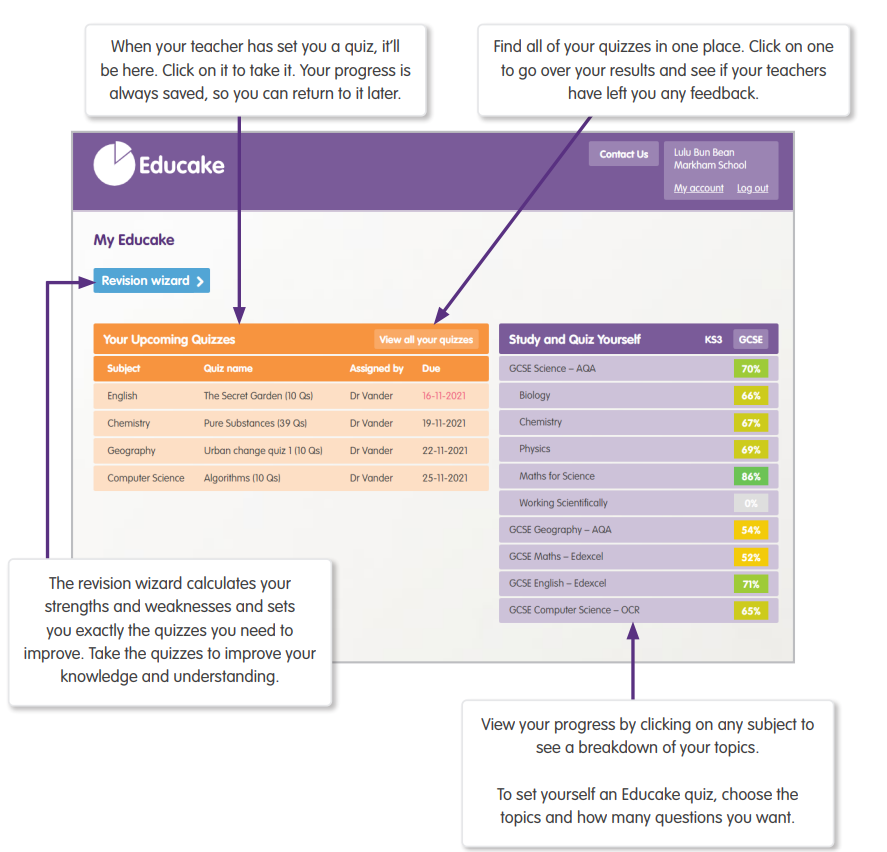
Educake is an online learning system for schools. Pupils can use it on a PC, tablet or smartphone by going to www.educake.co.uk.
Teachers might set quizzes on Educake for classwork or for practice at home. Quizzes can be retaken as many times as pupils want to improve their score. Every question is auto-marked, and pupils get instant feedback. Educake is all about progress and positivity.
Pupils also have the opportunity to learn independently. The “Practice” button shows them which topics they need to work on and creates personalised quizzes for them.
Educake Student Video
Educake Parent & Carer Information
Here’s a short video that gives parents & carers a quick overview of Educake.
Find out more
If you would like more information about our curriculum, please contact Mrs Smith, Headteacher using the details on our contact page.