
Curriculum
Computer Science
The Subject Way
Firstly, to teach students the vital skills they need to achieve their full potential and gain the very best grades they can. Secondly, to teach students how each subject relates to the wider world, incorporating the life skills they will learn.
It is our belief that knowing how what you learn links to the wider world brings a subject to life and therefore improves overall understanding and engagement.
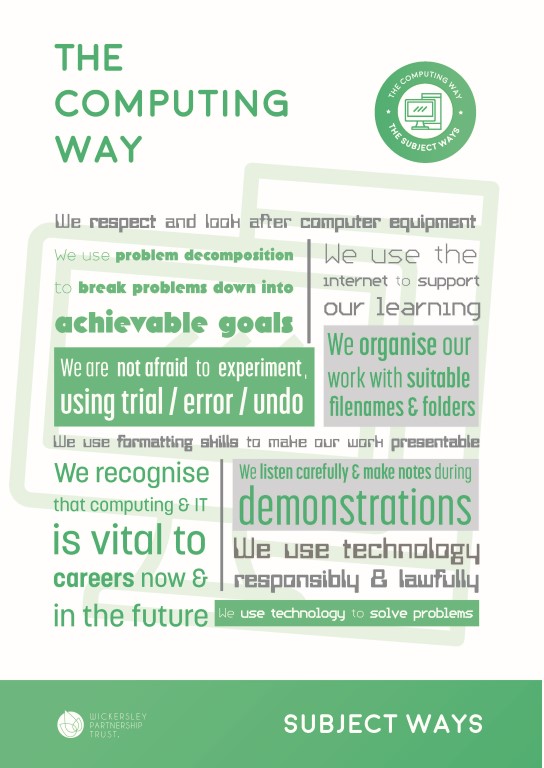
Our Intent
The ICT and Computer Science Curriculum core purpose is to deliver an engaging and challenging curriculum. The curriculum has been developed to respond to rapidly developing/emerging IT technologies in today’s world. The aim of which is to make our students into 21st Century Digital Citizens who are able to learn, communicate and collaborate safely and responsibly using computer technologies. We understand the need for all students to be confident in the use of ICT technologies and the wide role these technologies play in everyday life and career paths. The KS3 curriculum has also been planned to prepare students for KS4 options, we offer students the opportunity to study the OCR Creative iMedia and the OCR GCSE Computer Science Course.
How we intend to remove barriers
Students will be able to use ICT Technologies safely, responsibly and within the confines of the law. As part of this use students will learn how to use the school’s ICT systems and the range of Google Educational Apps. The ICT and Computing curriculum allows students to develop their Literacy and Numeracy skills. Numeracy skills will be developed through the Computing SOWs and Topics we offer. Students will have the opportunity to develop their Oracy skills in every lesson when answering questions or engaging in class discussions.
How we develop skills for learning
Throughout the ICT and Computing Curriculum students will develop creative skills by designing and creating Digital Media Products (Videos, Sounds, Websites and Interactive PowerPoints). Students will also be able to evaluate these products and determine if they are fit for purpose and fit the needs of the project brief/requirements.
In order to develop Analytical skills students will be able to debug broken programming code and be able to correct the errors in order to make the code work correctly. Through the writing of programming code students will develop Logical and Computational Thinking skills.
How we foster personal attributes
Aspects of the Rawmarsh Way are built into the ICT and Computing Curriculum. Students are taught to use ICT equipment safely and responsibly. Students will develop independence skills by undertaking and completing Digital Media projects in the ICT topics. Independence and Resilience skills will also be developed by students learning how to programming code in the Computer Science topics.
Overall, students will be able to develop fundamental ICT skills which will allow them to apply for a range of Higher Education courses or a range of careers, enhancing their employability when they leave Rawmarsh School.
How we intend to enrich student experiences and broaden the horizons of students
Students are given a range of opportunities to broaden their horizons in the ICT and Computing curriculum. Firstly students are taught a wide range of skills using different software packages, some of these packages are industry standard which students wouldn’t normally be able to access at home. The other software packages that we offer are free to use and download, which allow students to install these apps at home to further develop the skills they have learnt in lessons. Theory Topics such as Computer Ethics are planned around real life case studies, allow our students to gain a wider understanding of the world around them. They will also gain an understanding of how ICT technology can impact themselves and society as a whole.
When studying the Computing Topics students will have the opportunity to learn programming techniques in a range of programming language, giving them a wider breath of programming skills and knowledge. The department will also run in lesson workshops where students will have the opportunities to disassemble and reassemble computers in order to learn about how the devices work.
Year-by-Year Subject Breakdown
In Year 7 your child will study:
- Introduction to ICT
- E-safety
- Scratch programming
- Kodu programming
- Image Manipulation in GIMP
- Computing Fundamentals (Hardware, Software, Binary)
Your child’s progress will be assessed using in-class quizzes and tests, summative assessments at the end of each unit of work and a cumulative test at the end of the year, which will test everything they have learnt throughout Year 7.
Typical homework your child might get in Year 7 is:
- Binary/Denary conversions
- Research tasks
- Code annotation
In Year 8 your child will study:
- Text-Based Programming (Python)
- Data Modelling (Spreadsheets)
- Flowol for developing programming skills
- Networks
- Programming with Micro-bits
- App-inventor (Project work)
Your child’s progress will be assessed using in-class quizzes and tests, summative assessments at the end of each unit and a cumulative exam at the end of the year, which will test everything they have learnt throughout Year 8.
Typical homework your child might get in Year 8 is:
- Code annotation
- Research tasks
- Practice test questions
In Year 9 your child will study:
- Flowol/Algorithms
- Python Programming
- Network Security
- Image Manipulation
- Storyboarding and animation/video creation
- System Software
Your child’s progress will be assessed using in-class quizzes and tests, summative assessments at the end of each unit and a cumulative test at the end of the year, which will test everything they have learnt throughout Year 9.
Typical homework your child might get in Year 9 is:
- Pseudocode writing
- Practice test questions
- Completion of unfinished work to meet deadlines
In Year 10 your child will study:
- Computer Components and the inner workings of a computer system (CPU, etc.)
- Memory and Storage
- Wired and Wireless Networks (including topologies)
- System Security – attacks and preventions
- Ethical, legal and cultural concerns
- Programming Skills to complete a project
Your child’s progress will be assessed using in-class quizzes and tests, summative assessments at the end of each unit and a mock exam at the end of the year, which will test everything they have learnt throughout Year 10.
Typical homework your child might get in Year 10 is:
- Practice exam questions
- Revision
- Code Debugging
In Year 11 your child will study:
- Algorithms
- Programming Techniques
- Robust Programming
- Computational Logic
- Translators and facilities of languages
- Data Representations
Your child’s progress will be assessed using in-class quizzes and tests, summative assessments at the end of each unit and mock exams at two set points during the year, which will test everything they have learnt throughout Year 10 and 11.
Typical homework your child might get in Year 11 is:
- Revision
- Exam questions
- Flowchart/Pseudocode writing
Find out more
If you would like more information about our curriculum, please contact Mrs Smith, Headteacher using the details on our contact page.