
Curriculum
Dance
The Subject Way
Firstly, to teach students the vital skills they need to achieve their full potential and gain the very best grades they can. Secondly, to teach students how each subject relates to the wider world, incorporating the life skills they will learn.
It is our belief that knowing how what you learn links to the wider world brings a subject to life and therefore improves overall understanding and engagement.
Curriculum Intent
A high-quality physical education curriculum inspires all pupils to succeed and excel in competitive sport and other physically-demanding activities. It should provide opportunities for pupils to become physically confident in a way which supports their health and fitness. Opportunities to compete in sport and other activities, build character and help to embed values such as fairness and respect. We also aim to develop the social and emotional well-being of our students.
We aim to engender a love of learning, self-belief and aspiration through 4 key intentions:
- The removal of barriers
- Developing skills for learning
- Fostering of personal attributes
- Enriching student experiences and broadening their horizons
INTENTION 1 – The removal of barriers to learning
In Physical Education we remove barriers to learning and support students’ ability to access the curriculum through the development of literacy, numeracy, oracy skills and vocabulary acquisition. Students are introduced to key subject specific vocabulary and have regular opportunities to reinforce their understanding through low stakes testing. Students are given opportunities to read widely and often in order to develop their oracy within a subject specific context.
Misconceptions do not go unchallenged and the supportive environment within each and every lesson ensures that students develop their own literacy and vocabulary in a high challenge, low fear environment. Throughout each year of the curriculum numeracy and statistical skills are sequenced to become more complex over time to ensure students build on the fundamental aspects of each one and develop their confidence and aptitude.
INTENTION 2 – Developing skills for learning
Developing student knowledge and essential learning skills go hand in hand. Students need to remember with fluency in order to be fully established mini-subject specialists. We strive, at all times, for personal excellence by developing the 5 key skills for success below:
| Recall |
| Students in PE are consistently recalling learnt skills and developing these in conditioned and competitive practices. |
| Interpretation |
| Throughout their time students will be asked in lessons to interpret results of heart rates, physical and skill related tests. They will develop their interpreting skills during OAA and Duke of Edinburgh through map and compass work. |
| Creativity |
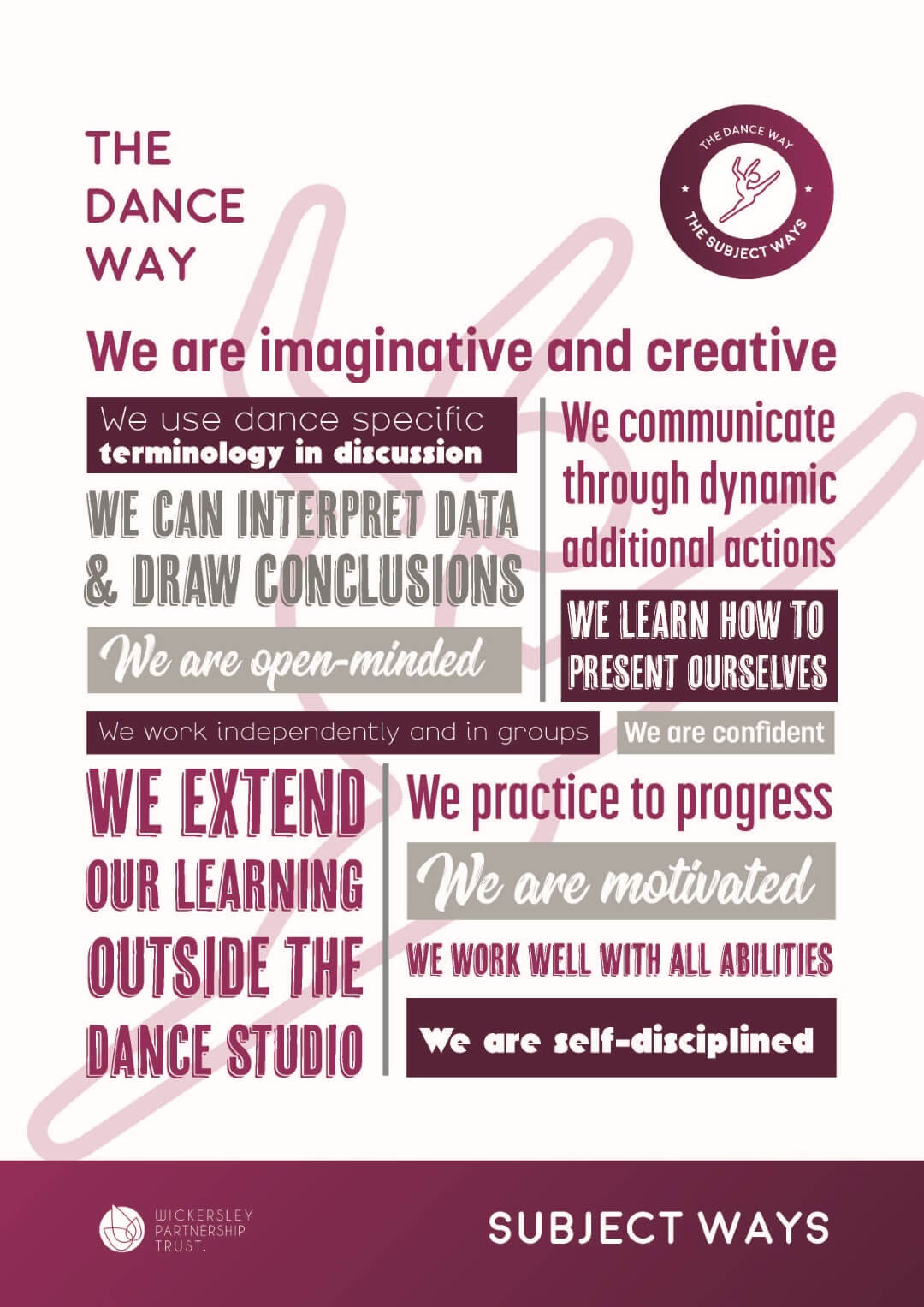
| All students will develop creativity through numerous units of work each year. During, dance and gym units students will be expected to be creative in their choreography and in games units developing creative ways to outwit opponents. |
| Analysis & Evaluation |
| Students develop this skill from the beginning of Y7 where they are taught how to analyse their own and others work. In all units of work communication is developed to ensure all pupils can give meaningful feedback to further develop skills. |
| Divergent thinking |
| Students are challenged in PE to find innovative solutions by looking at things from different angles e.g. attacking or defending. Creative risk taking in a high challenge low fear environment allows all students to think more divergently |
INTENTION 3 – Fostering personal attributes
In Y9 students follow pathways dependent on their areas of strength having completed Year 7. Students will continue to access a range, however, they will study a more specific curriculum. All students across Year 7 & 8 should understand what makes a performance effective and how to apply these principles to their own and others work.
In years 9, 10 and 11 students will continue to develop their character and physical competence as well as increasing their knowledge and understanding of the value of life long participation in Sport. This is done by ensuring lessons are both engaging and purposeful as well as additional opportunities for pupils to ‘try something new’ in the form of taster sessions. Pupils should tackle complex and demanding physical activities. They should get involved in a range of activities that develop personal fitness and promotes an active, healthy lifestyle.
Students can also choose to study a vocational qualification in sport, equivalent to one GCSE. They are assessed on Fitness for Sport and Exercise, Leadership, Practical Sports Performance, and Applying the Principles of Personal Training. This is all achieved by teaching theoretical content through and alongside high-quality practical PE.
Pupils will continue to take part in competitive sports and activities outside school through community links or sports clubs.
Students also have the opportunity to complete the Duke of Edinburgh at bronze and silver level. This further supports and develops the student’s skills and character.
INTENTION 4 – Enriching student experiences and broadening their horizons
| Our curriculum offers a variety of different trips to local colleges, theatres and music venues. |
| Visits from industry professionals that lead on subject-specific workshops. |
| The use of regular performance in lessons to increase confidence and decrease performance anxiety. |
| Opportunities to be a part of the school led full-scale musical productions that combine all 3 disciplines of the performing arts. |
| Extracurricular enrichment through school shows/concerts, choir, music technology and instrumental development. |
Year-by-Year Subject Breakdown
In Year 7 your child will study:
- Street dance/Hip Hop
- Musical Theatre
- Latin America/ Paso Doble
- Rock N Roll
- Safety in warm-ups
- Stamina/ Flexibility
Your child’s progress will be assessed using in-class quizzes and tests, summative assessments at the end of each half term and a cumulative test at the end of the year, which will test everything they have learnt throughout Year 7.
Typical homework your child might get in Year 7 is:
- A Kahoot challenge (able to do on phone or laptop)
- Research the history and origins of styles
- Learn certain actions from a video clip
In Year 8 your child will study:
- Musical theatre
- Show dance
- Lindy Hop
- Ballet
- Stomp
- Gumboot
Your child’s progress will be assessed using in-class quizzes and tests, summative assessments at the end of each half term and a cumulative exam at the end of the year, which will test everything they have learnt throughout Year 8.
Typical homework your child might get in Year 8 is:
- Research projects
- Kahoots to test knowledge
- Learning set pieces of choreography
In Year 9 your child will study:
- Evolution of Dance (many styles through the ages)
- Show dance
- Spoken Word/Contemporary/Lyrical
- Musical Theatre
- Professional practitioner repertoire
- Choreography techniques
Your child’s progress will be assessed using in-class quizzes and tests, summative assessments at the end of each half term and a cumulative test at the end of the year, which will test everything they have learnt throughout Year 9.
Typical homework your child might get in Year 9 is:
- Research professional practitioners
- Find and explain unusual dance styles from around the world
- Learn professional repertoire from video clips
- Complete lesson logs
In Year 10 your child will study:
- Professional Practitioners
- Professional repertoire
- Jazz
- Show dance
- Contemporary/Urban fusion
Your child’s progress will be assessed using in-class quizzes and tests, summative assessments at the end of each half term and an external exam at the end of the year.
Typical homework your child might get in Year 10 is:
- Completing online Learning journal weekly logs for component 1
- Researching and Learning routines from video clips
- Practicing routines learnt in class
In Year 11 your child will study:
- Choreographic approaches and techniques
- Constituent features
- Comparisons of Practitioners intentions
- Creating choreography in solo and groups
- Performance techniques
- Performing in front of audiences
Your child’s progress will be assessed using in-class quizzes and tests, summative assessments at the end of each half term and a mock exam during the year, which will test everything they have learnt throughout Year 11.
Typical homework your child might get in Year 11 is:
- Complete Audits
- Booking the dance studio to practice group routines
- Completing a learning journal and weekly logs for component 2
Department Staff
C Mills
Director
- cmills@gainsboroughacademy.com
C Bittles-Kincaid
Find out more
If you would like more information about our curriculum, please contact Mrs Smith, Headteacher using the details on our contact page.